
 Print
Print Description
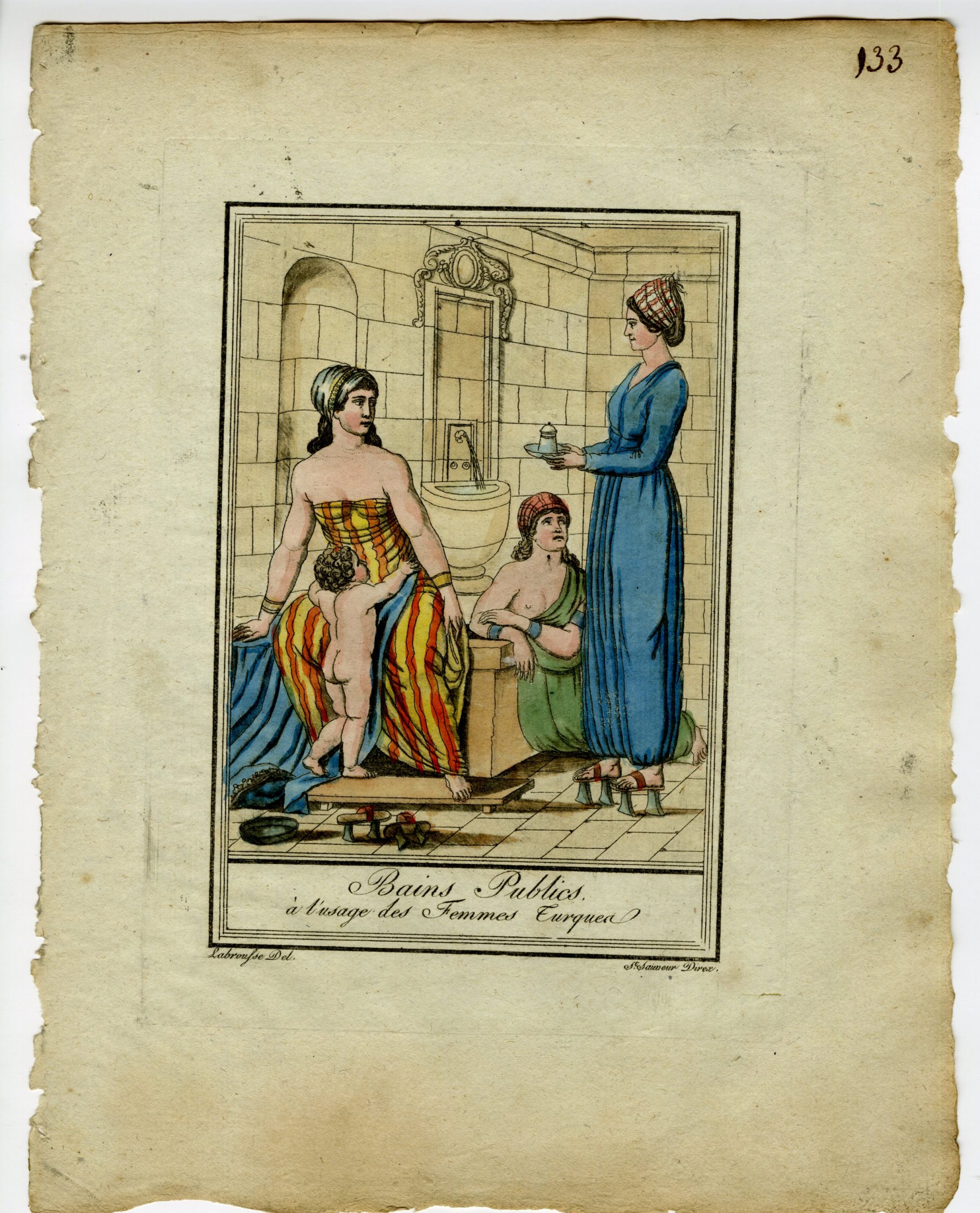
(Public Baths for the Use of Turkish Women) This print illustrates a scene inside a Turkish public bath, specifically used by women, known as a hammam. The setting is characterized by tiled walls and flooring, indicative of the traditional architecture found within such bathhouses. The women are depicted in various states of undress, which is typical for a hammam environment, where communal bathing is a cultural norm. The attire of the women, though minimal, is vibrant and adorned with patterns, suggesting a continued expression of personal style and cultural identity even in intimate settings. One woman is seated, draped in a colorful bath wrap, while another stands wearing a traditional head covering, holding what appears to be a container, possibly with water or traditional oils. The inclusion of a child adds to the depiction of the hammam as a social space, where women of all ages would gather not just for hygiene but for relaxation and community. The hammam plays a significant role in Turkish culture, serving as a place for both physical cleansing and social interaction.
Made by Labrousse after Jacques Grasset de Saint Sauveur.
Medium: Handcoloured line and aquatint etching on hand laid paper.
Sheet size: 20.5 x 26.1 cm (8.07 x 10.28 inch). Image size: 14.7 x 20.5 cm. (5.79 x 8.07 inch).
Condition: good, given age. Paper edges a bit irregular and brownish from binding. . General age-related toning and/or occasional minor defects from handling. Please study scan carefully.
TURKISH-CULTURAL-PRACTICES-HAMMAM-WOMENS-SOCIAL-LIFE-COMMUNAL-BATHING | PCO-C27-44
BACKGROUND INFORMATION
Costumes de Differents Pays …’ by Jacques Grasset de Saint Sauveur, c.1797.
Biography engraver: Labrousse was a late 18th C. French engraver.
Biography artist: Jacques Grasset de Saint-Sauveur (1757-1810) was born as son of a diplomat in Montreal, Canada. He was exposed to varying cultures at an early age.

Reviews
There are no reviews yet.