
 Print
Print Description
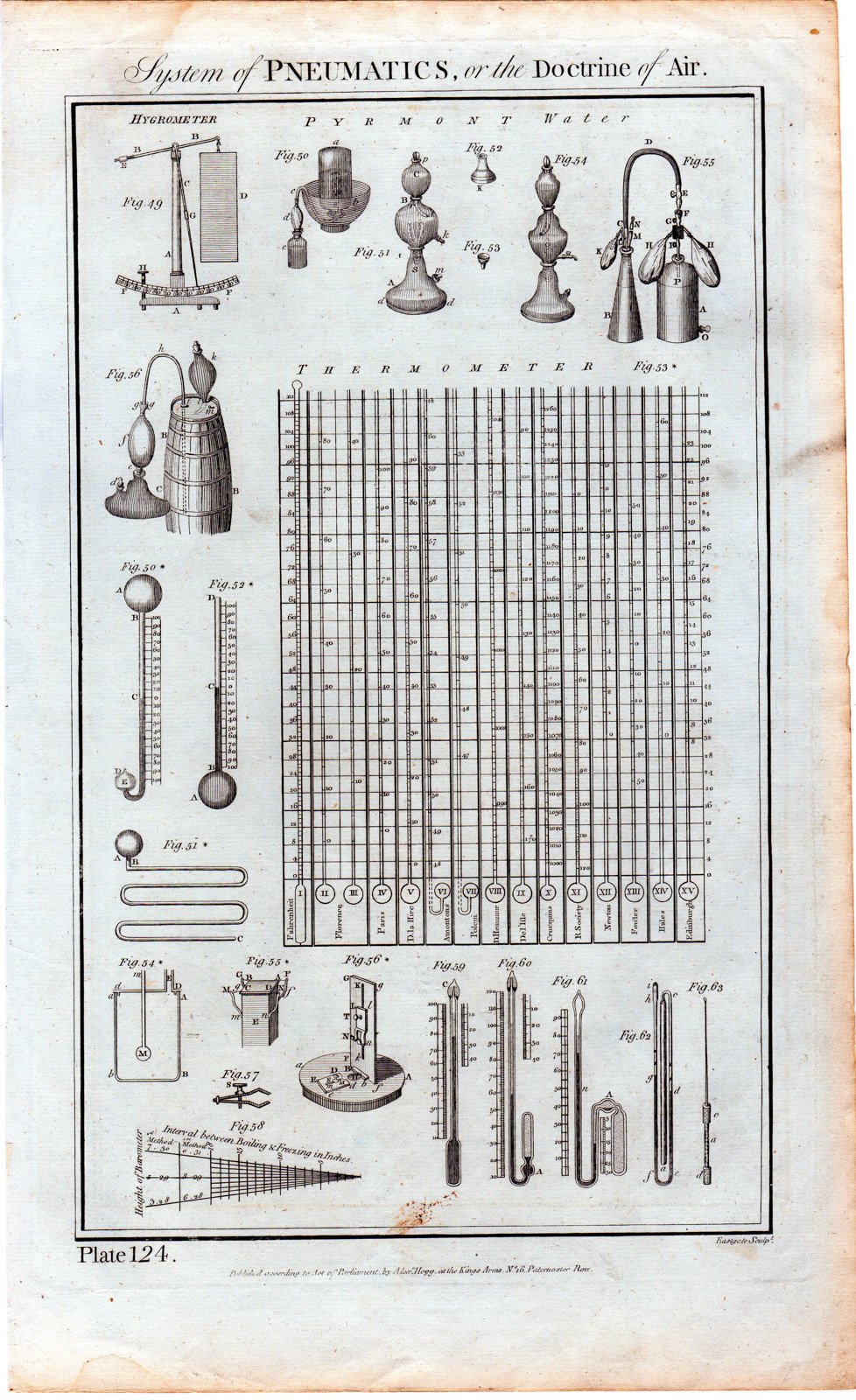
This print shows a view on a collection of scientific instruments used in the 18th century to study the properties of air and liquids. Hygrometers (Top Left): These devices, such as the one shown in Fig. 49, were used to measure the moisture content (humidity) of the air. Early versions often used organic materials like catgut or human hair, which expand or contract with moisture, moving a needle across a scale.
Pyrmont Water Apparatus (Top Right): Figs. 50–55 depict various vessels and tubes used to study “Pyrmont Water”—naturally carbonated mineral water. Scientists of this era, like Joseph Priestley, were obsessed with “fixed air” (carbon dioxide) found in these waters, which led to the invention of modern carbonated soft drinks.
The Large Central Chart (Thermometer Comparison): This is a detailed comparative scale of thermometers. During this period, there was no single standard for temperature. This chart allows a user to compare different scales used across Europe, such as: Fahrenheit (England/Holland), Réaumur (France), Celsius (often called Centigrade then)
Various obsolete scales like Newton’s or the Royal Society’s scale.
Pneumatic Instruments (Bottom):
Fig. 57 & 58: Likely related to barometers or pressure gauges.
Fig. 60–63: Various designs of thermometers and barometers, including “U-tube” manometers used to measure gas pressure.
Fig. 56: Shows a “Pneumatic Trough” setup, used for collecting gases over water or mercury.
Made by Eastgate after Howard.
Medium: Etching / engraving on handlaid (verge) paper.
Sheet size: 25.5 x 42 cm (10.04 x 16.54 inch). Image size: 21 x 35.2 cm. (8.27 x 13.86 inch).
Condition: good, given age. Brown edges. Creases. General age-related toning and/or occasional minor defects from handling. Please study scan carefully.
PNEUMATICS-SCIENCE-AIR-LIQUIDS-PYRMONT WATER-THERMOMETER-BAROMETER | RBOS-T43-LARGE
BACKGROUND INFORMATION
This attractive print was published in the New Royal Cyclopaedia and Encyclopaedia” (ook bekend als The New Royal Encyclopaedia Londinensis), samengesteld door George Selby Howard, 1788. Published by Alexander Hogg in Londen.

Reviews
There are no reviews yet.