
 Print
Print Description
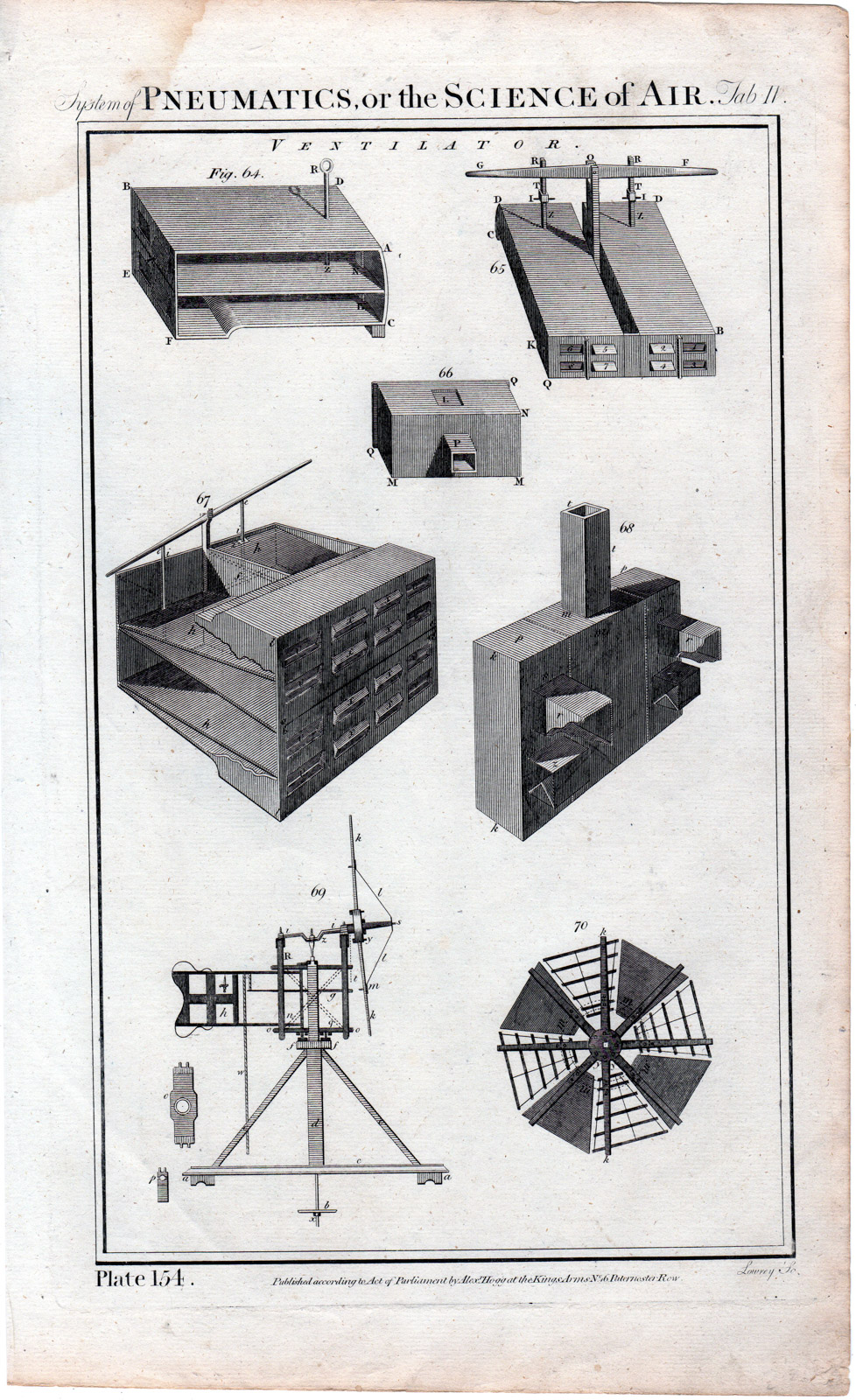
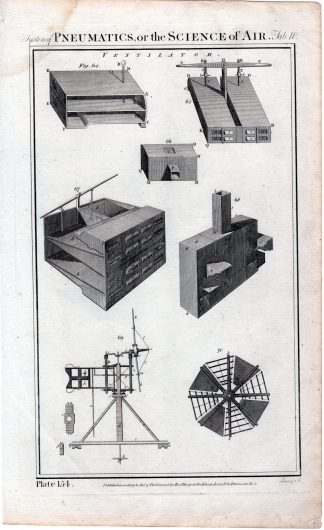
This print shows a view on a collection of scientific instruments used in the 18th century to study the properties of air and liquids, which shows the pioneering ventilation systems of the English scientist Stephen Hales (1677–1761). He was a pioneer on the issue of health. Why this was important In the 18th century, people did not yet understand exactly how bacteria worked, but it was seen that people in poorly ventilated spaces — such as ships, prisons and hospitals — became ill more quickly. The different figures (numbered from 64 to 70) show various designs of Hales’ bellows ventilation: Fig. 64 & 65 (Top): These are early designs of large bellows that were manually operated. These were used to pump “depraved” air out of confined spaces and replace it with fresh outside air. Fig. 67 (Middle left): Shows a cross-section of a ventilation system as installed on ships. It was essential to combat diseases such as scurvy and infections in the overcrowded holds. Fig. 70 (Bottom right): A top view of a windmill-like mechanism that could be used to drive the fans without the need for constant manpower.
Made by Lowrey after Howard.
Medium: Etching / engraving on handlaid (verge) paper.
Sheet size: 26 x 42 cm (10.24 x 16.54 inch). Image size: 21 x 35.2 cm. (8.27 x 13.86 inch).
Condition: good, given age. Brown edges. Creases. Water stains. General age-related toning and/or occasional minor defects from handling. Please study scan carefully.
PNEUMATICS-SCIENCE-AIR-LIQUIDS-STEPHEN HALES-VENTILATION SYSTEM-HEALTH | RBOS-T43-LARGE
BACKGROUND INFORMATION
This attractive print was published in the ‘New Royal Cyclopaedia and Encyclopaedia’ (ook bekend als The New Royal Encyclopaedia Londinensis), samengesteld door George Selby Howard, 1788. Published by Alexander Hogg in Londen.



Reviews
There are no reviews yet.